| ** | Latin American Journal of Clinical Sciences and Medical Technology is an open access magazine. To read all published articles and materials you just need to register Registration is free of charge. Register now If you already have registered please Log In | ** |

aPlastic Surgery Service, Red Cross Central Hospital, Universidad “Alfonso X el Sabio”, Madrid, Spain; bDepartment of Combustiology, Reconstructive and Plastic Surgery of the Kharkiv Medical Academy of Postgraduate Education, Kharkiv, Ukraine; cPlastic and Reconstructive Surgery, "Dr. Domingo Luciani" Hospital, Caracas, Venezuela; dLaboratories Proteos Biotech S.L., Madrid, Spain; eHealthSkin, Ciudad de México, México.
Corresponding Author: , . Telephone number: ; e-mail: damarin.rivera@gmail.com

Lat Am J Clin Sci Med Technol. 2024 Aug;6:167-173.
Received: May 22nd, 2024.
Accepted: July 16th, 2024.
Published: August 6th, 2024.
Views: 2514
Downloads: 14

Introduction. Skin acts as a complete barrier protecting against external aggressions and keeps the body's internal balance. The loss of its firmness and elasticity is a complex process associated with cutaneous aging, which implies intrinsic and extrinsic factors that promote changes in the dermis, epidermis, and abnormal pigmentation. In recent years, treatments for improving skin health and beauty have advanced significantly, which has raised great interest in the related technology. Objective. To evaluate the efficacy and tolerability of pbserum smartker Equilibrium Professional in terms of skin firmness and tone improvement, wrinkle reduction, and visible signs of skin aging. Materials and Methods. A non-controlledstudy was carried out on 22 subjects aged 24 to 70 years old. They had normal and mixed skin with minor imperfections, excluding those with relevant dermatologic pathologies or under specific treatments. Measurements were made by subjective dermatologic evaluation, high-definition photography with the VISIA® device, and non-comedogenicity evaluation. Subjects applied the product once a week for four weeks, and the product was well tolerated with no reported adverse effects. Results. An average improvement of 27% was observed regarding the unification of skin tone and imperfections after 28 days of use; 77% of the patients were satisfied, and 63% were willing to buy the product. The dermatologic evaluation did not find evidence of comedogenicity, high user satisfaction and good product tolerability. Conclusions. A significant improvement was shown in tone unification and skin imperfections, with high satisfaction from the users and a good tolerability of the product.
Introducción. La piel actúa como una barrera protectora completa que protege de las agresiones externas y mantiene el balance interno del cuerpo. La falta de firmeza y elasticidad de la piel es un proceso complejo que se asocia con el envejecimiento cutáneo, lo cual implica factores intrínsecos y extrínsecos que promueven cambios en la dermis, epidermis y pigmentación anormal. Objetivo. Evaluar la eficacia y tolerabilidad de pbserum smartker Equilibrium Professional en términos de firmeza, mejoría del tono de la piel, reducción de arrugas y signos visibles de envejecimiento. Material y métodos. Se llevó a cabo unestudio no controlado en 22 sujetos entre 24 y 70 años de edad, que tenían piel normal y mixta con imperfecciones. Se excluyó a los pacientes que tuvieran patologías dermatológicas relevantes o que estuvieran bajo tratamientos específicos. Las mediciones se realizaron mediante una evaluación dermatológica subjetiva, un dispositivo VISIA® de alta definición fotográfica y con base en una valoración de no comedogenicidad. Los participantes se aplicaron el producto una vez a la semana durante cuatro semanas y siguieron un protocolo estricto para evitar interferencia de otros productos cosméticos. Resultados. Se observó mejoría promedio de 27% con respecto a la unificación del tono de la piel y a las imperfecciones después de 28 días de uso del producto; 77% de los pacientes estaba satisfecho y 63% estaba dispuesto a comprar el producto. La evaluación dermatológica no encontró evidencia de comedogenicidad, el producto fue bien tolerado y no se reportaron efectos adversos. Conclusiones. Se mostró mejoría significativa en la unificación del tono de la piel y en las imperfecciones; los pacientes mostraron alta satisfacción y tolerabilidad al producto.
Skin acts as a complete barrier protecting against external aggressions and keeps the body's internal balance. This barrier function is achieved mainly through the stratum corneum formed by compressed corneocytes full of keratin, creating fortified nets.
Keratin's structure creates a biopolymer resistant to conventional proteolytic degradation. Its primary function is to support epithelial cells and tissues. Keratinases, a specific type of proteolytic enzyme, have gained importance in the clinical use of enzymes due to their capacity to break down keratin-rich substrates. These enzymes can function at a wide range of temperatures and pH levels.
The potential of keratinases in biotechnological applications has been recognized for a while, offering sustainable solutions for industrial and environmental processes and biomedical, pharmaceutical, and cosmetic applications.1 In recent years, treatments for improving skin health and beauty have advanced significantly, which has raised great interest in the related technology.
The loss of firmness and elasticity is a complex process associated with cutaneous aging, which implies changes in the dermis, epidermis, and abnormal pigmentation.2 Such changes include collagen and elastic fibers breakdown and alterations in glycoproteins and proteoglycans that maintain the skin's structure and density, resulting in thinner and less soft skin contributing to skin aging.2,3
Intrinsic factors (such as chronologic aging) and extrinsic ones (like diet, lifestyle, exposure to pollution, lack of hydration, exposure to irritating agents, and sun exposure damage) act in synergy to accelerate skin aging and loss of firmness.4
As a result, the skin becomes flabby, loses luminosity, and suffers from hydration loss.4 Keeping the skin's ability to recover its original form after stretching, compressing and keeping its tension and resistance to flabbiness are essential to maintaining a youthful and healthy skin; peelings with recombinant enzymes can be an effective tool.3
There are cosmetic peelings, but they are abrasive and cannot be used on sensitive skin. In the cosmetic dermatology field, biotechnology develops products with recombinant DNA technology that allow the manipulation of genetic material to produce superior-quality compounds at a large scale. Microorganisms and enzymes are used to make specific recombinant products.5 To be precise, using enzymes as treatment is a minimally invasive option in the aesthetics field6 and has shown to be a helpful tool.7,8
A new concept called dual delivery system has also been developed. Unlike the peelings, it promotes cellular regeneration of the superficial layers while enhancing the permeability of the nutrients.
The dual delivery system is based on recombinant enzymes, like the combination of keratinase PB333, vitamin A, vitamin C, and vitamin E.5 This mix of active compounds promotes fibroblast recovery, restoration of collagen and elastin, and it also improves skin's hydration and luminosity. It also creates a natural barrier against external factors that accelerate skin aging.7,9,10 Its component keratinase PB333 is an enzyme obtained from Bacillus licheniformis with recombinant technology, which makes it highly selective and active on the specific substrate.
Keratinase is directed to keratin in the corneo-desmosomes intermediate filaments, links between the corneous stratus corneocytes. The active ingredients penetrate the dermis and reach the epidermis with this mechanism.11
A recent study with scanning electron microscopy observed that keratinase PB333 creates grooves and eliminates cellular superposition in the skin, inducing cellular renovation and the separation of keratinocytes. This increases the penetration of active ingredients, as shown in transdermic absorption tests, where keratinase increases the accumulation of ascorbic acid and enhances cutaneous permeability. Keratinase at 5000 U showed a significant increase in the accumulation of active ingredients and skin permeability.1
Vitamins A, C, and E are natural antioxidants that increase muscle tone, improve elasticity and firmness of the skin, act as antioxidants against UV radiation, prevent hyperpigmentation, and are a cofactor in the synthesis of new collagen fibers.11
Vitamin C is a well-known antioxidant that inhibits tyrosinase by interacting with copper ions at tyrosinase active sites. As a topical product, it protects against UVB and UVA, which are unrelated to sunscreen effects.12
With the biotechnological support of the dual delivery system, pbserum is the first therapeutic system based on recombinant enzymes and vitamins in products (such as pbserum smartker Equilibrium Professional), which offer an effective solution to improve skin's elasticity and luminosity, fighting opacity related to skin aging.7 This comprehensive approach improves skin's quality and gives it a more youthful and healthful appearance.
The pbserum smartker Equilibrium Professional targets facial flabbiness, lack of firmness and elasticity, irregular skin tone irregularities, and the signs of mature skin aging. Its use has improved skin firmness and tone, diminishing wrinkles and signs of aging, a firming and softening effect, and a rejuvenated, more luminous appearance.10
Therefore, it can be said that the product promotes cellular renewal and increases permeability while respecting the skin's barrier effect, enhancing the retention of active ingredients up to nine times with a low immunogenic potential. Studies have evaluated those benefits with patients with all skin types, including sensitive and atopic, and have shown significant efficacy. No adverse effects were reported.11
Study Design
A non-controlled follow-up study was conducted to evaluate the efficacy and tolerability of the cosmetic product pbserum smartker Equilibrium Professional during four weeks of continuous use on the face and neck between February to March 2023. The objectives included evaluating skin firmness, tone improvement, wrinkle reduction, and visible signs of skin aging. The final evaluation was performed on day 28 of the study.
Patients
Twenty-four men and women between 24 and 70 years old from different private clinics of the participating countries were included. They had various types of skin (sensitive and non-sensitive), including normal and combination skin with slight imperfections (blackheads, pimples, spots). The following patients were excluded: patients with relevant dermatologic pathologies like atopic dermatitis, psoriasis, lupus, tinea or ringworm, pregnant or breast-feeding women, transplanted patients, immunosuppressed, patients with known allergies to cosmetic or industrial products, nor with history of photosensitivity, cardiovascular, gastrointestinal, neurological, metabolic, hematological or psychiatric diseases, patients under treatment with antibiotics, antihistaminic, azelaic acid or any anti-acne treatment during 15 days before the study. A total of 22 subjects completed treatment.
The study was conducted according to the Good Clinical Practices Principles and the Helsinki Declaration. All subjects gave written informed consent before the start of the study.
Measurements
The efficacy of the product smartker Equilibrium Professional was measured using subjective dermatologic evaluation, clinical graduation of tone unification, and reduction of imperfections after applying the product (baseline) and after four weeks of its continuous use.
For this study, we have defined small skin imperfections as slight lesions, anything from milia to moles to skin tags, blackheads, pimples, small scars, spots, and birthmarks.13 We used a Likert imperfection index scale to measure different experimental times.
An evaluation of tone unification and imperfections reduction was carried out. This parameter was evaluated on the first day before applying the product (baseline) and after four weeks of continuous use, using a nine-point evaluation scale for global severity, pigmental intensity, percentage of the hyperpigmented facial area, hyperpigmentation grade and presence of erythema, dryness, burning, and skin desquamation.
High-definition pictures were taken with the VISIA® device after applying the product (baseline) and after four weeks of continuous use. These high-definition pictures were taken in three positions and under different kinds of light, allowing the study of the skin's deep and superficial layers. VISIA®'s multi-point positioning system and live image overlay allow for the documentation of progress using cross-polarized and UV lighting to record and measure surface and subsurface skin conditions. UV photography provides data for sun damage assessment and analysis. This device combines a state-of-the-art image capture unit with software that precisely analyzes and diagnoses skin conditions.
Additionally, a non-comedogenicity dermatologic evaluation was made by counting acne lesions before the product's application (baseline) and after four weeks of continuous use. The evaluated parameters were closed comedones, open comedones, papules, pustules, cysts, and nodes.
Finally, possible adverse symptoms were monitored to evaluate the product's tolerance. The included parameters were desquamation, dryness, acne-prone skin, redness, spots, edema, vesicles, and others on a five-point scale (absence, very mild, mild, moderate, intense). Dermatologists also recorded if a subject presented another type of alteration. It was indicated if the observed anomalies related to the product's use according to the scale were unrelated, unlikely, possible, probable, certain, and unevaluable. Dermatologic exam results were recorded on an individual evaluation sheet.
Treatment
The eligible subjects were instructed to apply 3 ml of the cosmetic product pbserum smartker Equilibrium Professional, a watery undiluted solution, once a week for 28 days on clean skin and give a slight massage until the complete absorption of the product. The participants were instructed not to use any other product they did not use regularly.
Inclusion and exclusion criteria were checked during the initial visit (day 0). Informed consent forms were signed. A dermatologic evaluation was performed before the product's application, some HD pictures were taken, and a tolerance and non-comedogenicity evaluation was done.
Patients had an appointment 28 days later (D28 of continuous use of the product) for a follow-up dermatologic evaluation of efficacy, repeating the HD photographs, subjective questionnaire, and dermatologic assessment of tolerance and non-comedogenicity.
Statistical Analysis
A descriptive analysis of the biometric parameters results was done for the patients having treatment at every point of the experimental time. These statistics included mean, standard deviation, and absolute variation from baseline. Graphs were used to illustrate the average tendency of the response variables. Box diagram graphs were used to identify unusual variables in data (boxplot). These allow an effective visualization of any value that popped out from the others due to its high or low position in the diagram. A calculation of the third quartile was performed (the value with 75% of the values in an acescent order under it), considering critical atypic values over three times the third quartile value.
Mixed effects linear models (MKE) were used at every point of experimental time to evaluate the treatment's impact. Since the obtained measurements over time were correlated, aleatory effects were included for every patient, allowing the baseline to vary randomly between patients.
All the models used for data analysis were based on the "lme" function of the R software package called "nlme". When adjusting data using mixed effects linear models was not possible, a Student's t-test was used if data followed a normal distribution or the range test with Wilcoxon sign if data did not adjust to a normal distribution. If the null hypothesis that there were no differences between the experimental timeline point evaluated and the baseline was rejected, we concluded there were significant differences between that point in time and the baseline. A signification level of 0.05 (confidence interval 95%) was used for all the statistical tests in the study.
A total of 24 subjects were recruited; 2 dropped out of the study because of non-compliance; thus, 22 subjects were evaluated, 19 women and 3 men. Ages for the included patients were: for women, 3 were 18 years old, one was 19, 11 were between 21 and 29, 3 women were between 33 and 39, and 1 was 50. For men, the ages were 37, 39 and 50 years old. None of the subjects showed cutaneous alterations after 28 days of continuous product use.
Dermatologic Evaluation of Non-comedogenicity
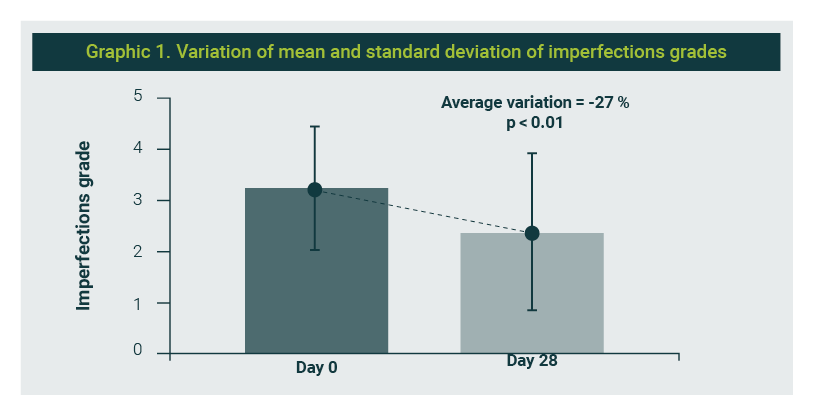
The dermatologist in charge evaluated open comedones, closed comedones, papules, pustules, nodes, and cysts before using the product and after 28 days of continuous use. The number of patients with high-grade imperfections diminished (percentage of subjects with diminished imperfections is shown in graphic 1). Tone and imperfections significantly improved by 27% in 68% of patients.
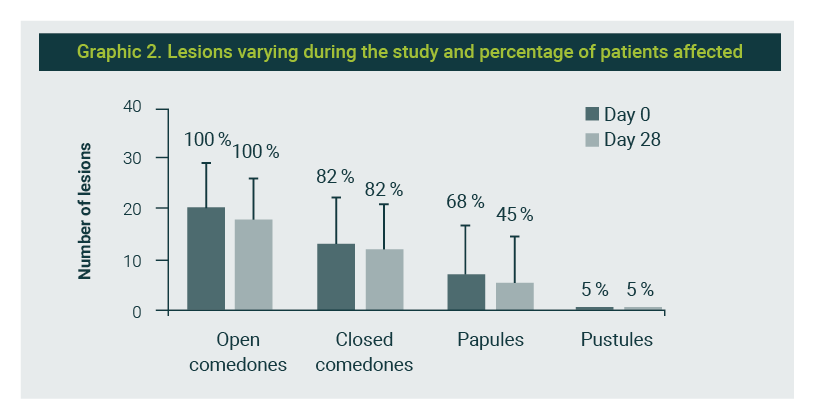
After 28 days of continuous use of the product, none of the subjects developed new open or closed comedones, nodules, or new cysts during the study.
In that same period, one subject (5%) developed new papules, while another one (5%) developed new pustules, as shown in graphic 2. In conclusion, the dermatologist did not consider that they were indications of comedogenicity, according to the number of acne lesions developed after using the product, the severity of the lesions, and the number of subjects who developed new lesions.
Dermatologic Evaluation of Efficacy Through Clinical Classification
After 28 days of continuous use, tone unification and skin imperfections improved 27% on average compared to baseline. This difference is statistically significant with a p-value under 0.05.
Subjective Evaluation of the Product after 28 Days of Continuous Use
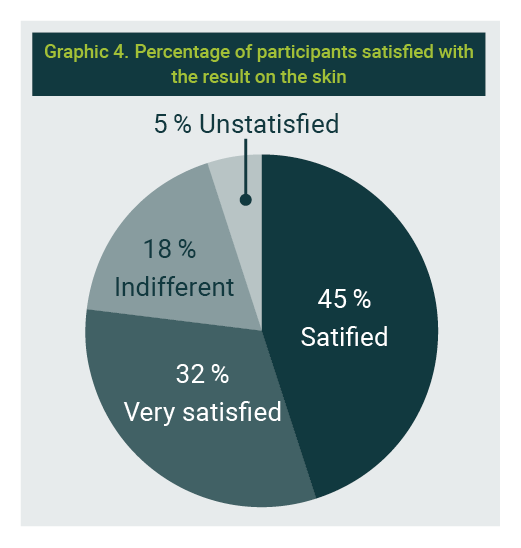
Graphic 3 shows the global subjective evaluation that patients carried out about the product's effectiveness. Graphic 4 shows the global satisfaction evaluation of patients carried out at the end of the study.
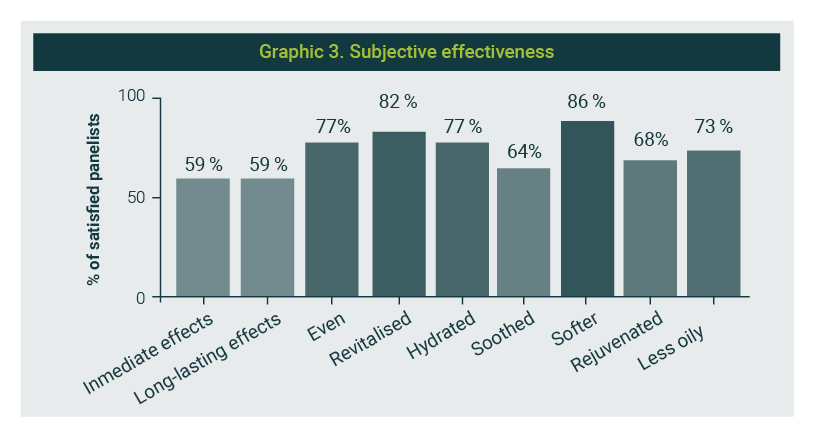
At the end of the treatment, 77% of the patients answered that the product met their skin texture and hydration expectations; 82% answered that their skin felt revitalized, and 80% responded that the skin felt softer.
Results are shown with VISIA® images before (Picture 1) and after treatment (Picture 2).
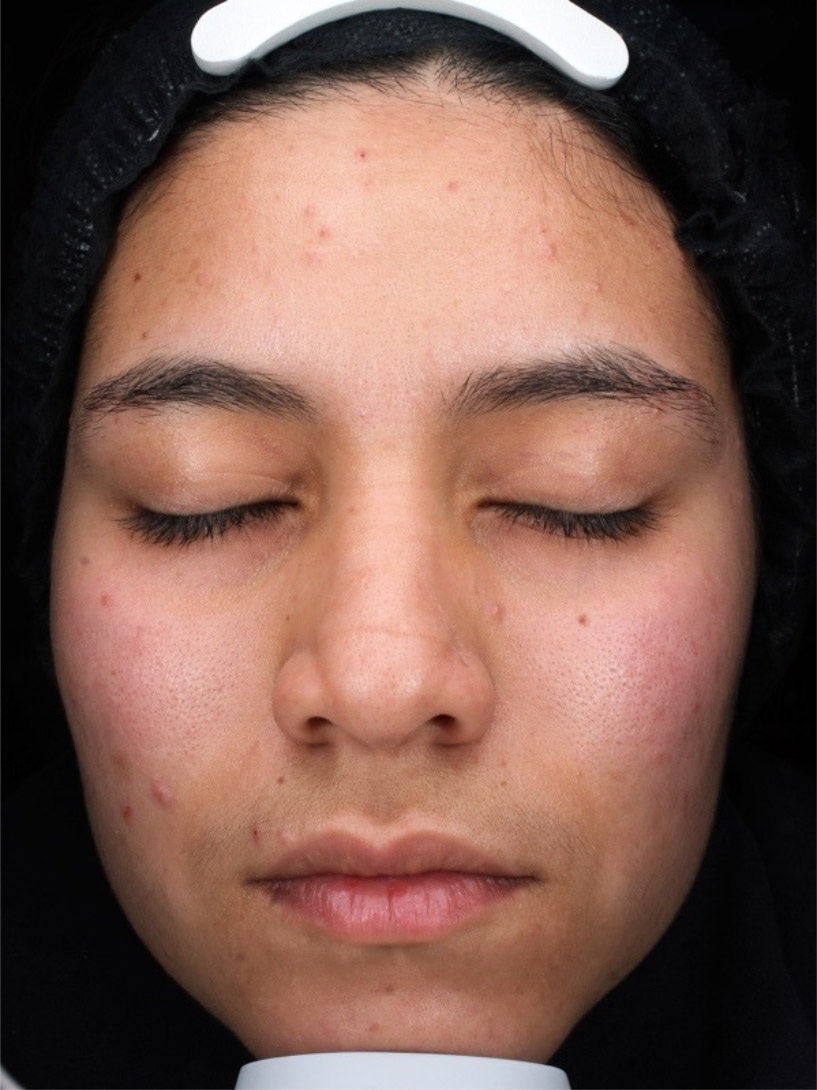
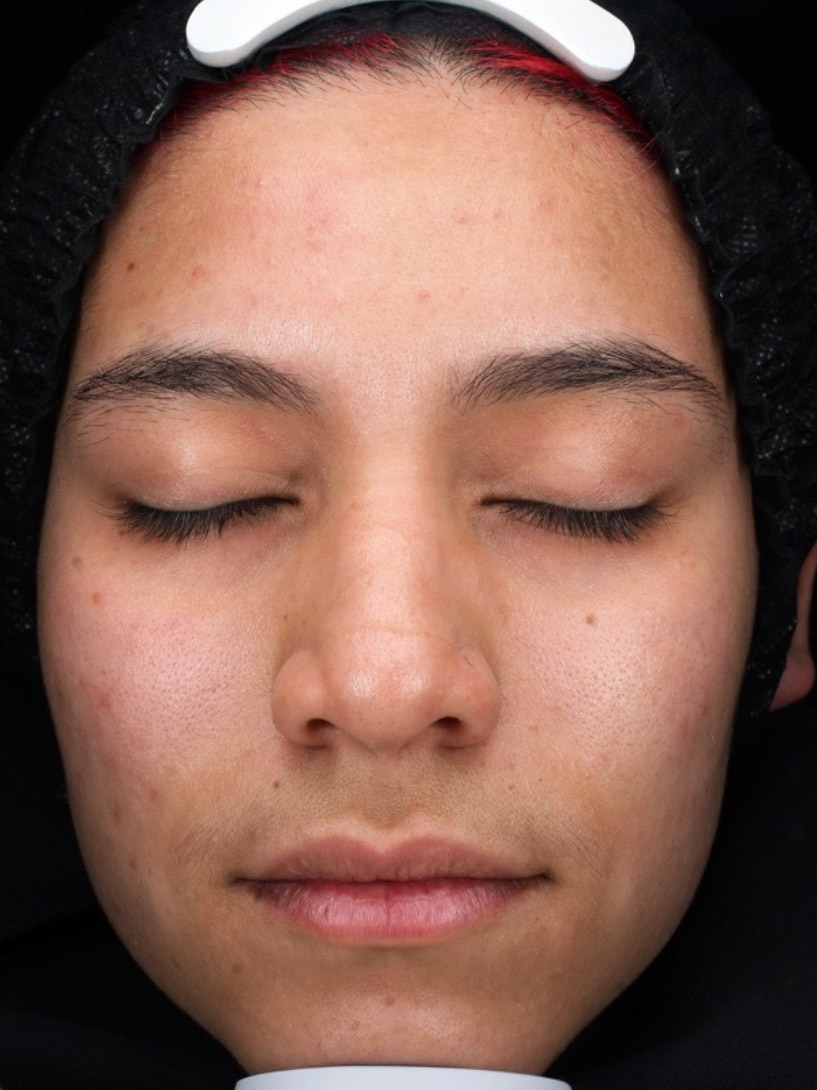
The study's results demonstrated a statistically significant improvement: with a p-value less than 0.05 in tone unification and skin imperfections in the group of subjects that used the product.
After four weeks of continuous use, tone unification and skin imperfections improved by a mean of 27% compared to baseline; 77% of the panelists were satisfied with the product's result on their skin, meeting their expectations filled, and 63% of the panelists would buy the product.
Regarding the dermatologic evaluation of non-comedogenicity, the dermatologist concluded that there was no evidence of comedogenicity. According to the dermatologist's clinical exam, none of the patients presented skin alterations after four weeks of continuous use of the product; therefore, the product was well tolerated, and no adverse events were reported.
It is necessary to conduct more prospective studies with larger samples to standardize the doses and procedures. Furthermore, comparative studies are required where the use of post-treatment sunscreens is controlled, as some may contain active substances in addition to the sunscreen.
Dr. Jorge Berroa López works for Proteos Biotech, pbserum smartker Equilibrium Professional; the rest of the authors do not have any conflict of interest.
| 1. | Montaño JRM, García MPC, Kopytina V, Berroa JL. Exploring new functions of keratinases: Skin deposition and permeability. Cosmetics. 2024; In press. |
| 2. | Michalak M, Pierzak M, Kręcisz B, Suliga E. Bioactive compounds for skin health: A review. Nutrients. 2021;13(1):203. |
| 3. | Healthline. Skin elasticity: 13 ways to improve it. [Retrieved on July 18th, 2024]. Available from URL: https://www.healthline.com/health/beauty-skin-care/skin-elasticity |
| 4. | Rostkowska E, Poleszak E, Wojciechowska K, Dos Santos Szewczyk K. Dermatological management of aged skin. Cosmetics. 2023;10:55. |
| 5. | Gomes C, Silva AC, Marques AC, Lobo JS, Amaral MH. Biotechnology applied to cosmetics and aesthetic medicines. Cosmetics. 2020;7(2):33. |
| 6. | Rivera PZM. Uso de enzimas como tratamiento dermatológico regenerador de las líneas de expresión. Vive Revista de Salud. 2020;3(8):77-84. |
| 7. | Fierro-Arias L, Campos-Cornejo NG, Contreras Ruiz J, Espinosa-Maceda S, López-Gehrke I, Márquez-Cárdenas R, et al. Productos enzimáticos (hialuronidasa, colagenasa y lipasa) y su uso en Dermatología. Dermatol Rev Mex. 2017;61:206-219. [Consultado el 18 de julio, 2024]. Disponible en URL: https://dermatologiarevistamexicana.org.mx/article/productos-enzimaticos-hialuronidasa-colagenasa-y-lipasa-y-su-uso-en-dermatologia/ |
| 8. | Sunar K, Kumar U, Deshmukh SK. Recent applications of enzymes in personal care products. In: Dhillon GS, Kaur S, editors. Agro-industrial wastes as feedstock for enzyme production: Appply and exploit the emerging and valuable use options of waste biomass. Academic Press; 2016. p. 279-298. |
| 9. | pbserum Professionals. Monografía del producto. pbserum Smartker Extreme Firmness. [s.f.], 14 pp. [Consultado el 18 de julio, 2024]. Disponible en URL: https://professionals.pbserum.com/es/lessons/firmness/ |
| 10. | pbserum. Extreme Firmness. [Consultado el 18 de julio, 2024]. Disponible en URL: https://pbserum.com/products/cosmeceuticals/facial/equilibrium/ |
| 11. | Gianeti MD, Gaspar LR, Camargo Jr FB, Campos PM. Benefits of combinations of vitamin A, C and E derivatives in the stability of cosmetic formulations. Molecules. 2012;17(2):2219-30. |
| 12. | Murray JC, Burch JA, Streilein RD, Iannacchione MA, Hall RP, Pinnell SR. A topical antioxidant solution containing vitamins C and E stabilized by ferulic acid provides protection for human skin against damage caused by ultraviolet irradiation. J Am Acad Dermatol. 2008;59(3):418-25. |
| 13. | Goodman GJ, Armour K, Ong D, Tienthavorn T, Wu Y, Chen PC, et al. An absence of imperfections: A proposed framework for defining, assessing, and achieving skin glow. J Cosmet Dermatol. 2024;23(1):161-171. [Retrieved on July 18th, 2024]. Available from URL: https://research-repository.uwa.edu.au/en/publications/an-absence-of-imperfections-a-proposed-framework-for-defining-ass |
All Rights Reserved® 2019
Latin American Journal of Clinical Sciences and Medical Technology,Continuous Publication • Responsible Editor: Gilberto Castañeda Hernández • Reservation of Exclusive Use Rights: 04-2019-062013242000-203; ISSN: 2683-2291; both granted by Instituto Nacional del Derecho de Autor. • Responsible for the last update of this issue, Web Master Hunahpú Velázquez Martínez.
Calle Profesor Miguel Serrano #8, Col. Del Valle, Alcaldía Benito Juárez, CP 03100, Ciudad de México, México. Telephone number: 55 5405 1396 • Last modified on August 28th, 2026.
Privacy Policy
Latin American Journal of Clinical Sciences
Latin American Journal of Clinical Sciences (Lat Am J Clin Sci Med Technol) is committed to protecting the privacy and personal data of authors, editors, readers, and other users who interact with its editorial and digital platforms. This privacy policy describes how we collect, use, store, and protect such information.
1. Data controller
Lat Am J Clin Sci Med Technol is responsible for the processing of personal data collected through its website, manuscript submission system, and other official publishing channels.
2. Personal data we collect
Lat Am J Clin Sci Med Technol may collect and use internally (without sharing with third parties) the following personal data:
- Full name
- Institutional affiliation
- ORCID (when the author provided)
- Professional and academic information
- Data associated with manuscript submission, peer review, and editorial processes
- IP address, cookies, and website navigation data
- Administrative information required for scientific publication
No sensitive personal data is deliberately collected.
3. Purpose of data use
Personal data is used exclusively for the following purposes:
- Management of the editorial process (submission, peer review, editorial decisions, and publication)
- Communication between authors, reviewers, and editors
- Indexing, dissemination, and academic archiving of published articles
- Compliance with ethical, legal, and regulatory standards
- Improving website performance and security
- Production of internal statistics on use and editorial performance
4. Legal basis for data use
The processing of personal data is based on:
- The user's explicit consent
- The need to execute the editorial and contractual process
- The legitimate interest of Lat Am J Clin Sci Med Technol in the dissemination of scientific knowledge
- Compliance with applicable legal and ethical obligations
5. Confidentiality and peer review
Lat Am J Clin Sci Med Technol guarantees confidentiality of submitted manuscripts and the peer review process. The data of authors and reviewers will not be disclosed outside the editorial scope, except when strictly necessary for scientific publication or by legal requirement.
6. Data sharing
Some data may be shared only with:
- Editorial management platforms
- Indexing and registration services (e.g., Crossref, PubMed, DOAJ)
- Technology providers needed for website operation
- Competent authorities, where there is a legal obligation
Under no circumstances will the data be sold or used for commercial purposes unrelated to publishing.
7. Data retention
The personal data will be kept:
- For the time required for editorial and publication management
- As long as the article remains published as part of the academic archive
- As required by applicable legal or regulatory obligations
8. Information security
Lat Am J Clin Sci Med Technol implements reasonable technical and organisational measures to protect personal data against unauthorised access, loss, alteration or improper disclosure.
9. Rights of the owners of the information
Users are entitled to:
- Access to their personal data
- Request correction of incorrect information
- Request the deletion of their data, when legally possible
- Object to the processing of their data
- Request the limitation or portability of data
Requests may be submitted through the official channels of Lat Am J Clin Sci Med Technol.
10. Use of cookies
The website of Lat Am J Clin Sci Med Technol may use cookies and similar technologies to improve user experience, analyze traffic and optimize the functioning of the portal. Use of the site implies acceptance of these cookies.
11. Changes to the privacy policy
Lat Am J Clin Sci Med Technol reserves the right to update this Privacy Policy at any time. The modifications will be published on the official website and will take effect upon their publication.
12. Privacy policy acceptance
Submission of manuscripts, registration as a user or use of the website implies express acceptance of this Privacy Policy.